

Venezuela's Oil Boom Is Model To End Iran War
May 08, 2026
New York Times is screeching that Trump can’t negotiate ending the Iran War and opening the Hormuz Strait. Despite earlier Times’ claims that Trump would fail in Venezuela, his ‘Art of the Deal’ negotiating flipped America’s multi-decade enemy into a massive oil boom led by the U.S.
President Trump’s ‘Art of the Deal’ book featured an 11-point negotiating strategy that emphasized three key strategic moves to maximize real estate development or world domination:
Mountain Top Times' Substack is a reader-supported publication. To receive new posts, subscribe below. To support my work, consider becoming a paid subscriber.
· Make Extreme Initial Demands: Starting with a high, almost unrealistic demand, to anchor negotiations;
· The “Madman” Strategy: Using unpredictable or aggressive tactics to rattle opponents; and
· Walking Away: Being willing to leave the table to show you are not desperate.
Trump made extreme demands on Venezuela and Iran to surrender their sovereignty to the U.S. When the booth nations refused, madman Trump launched military actions. The move surprised both targets, infuriated European allies, and scared Russia and China as peer competitors.
The Venezuela War was over in 41 minutes with the kidnapping of President Maduro. The Iran War was really over in the first 2 hours with the U.S. and Israel decapitating Ali Khamenei: Supreme Leader of the Islamic Republic and Commander-in-Chief of the Armed Forces, along with 51 of the highest members of Iran’s political and military leadership.
The Mountain Top Times reported after the first 8 days that America’s war with Iran could not continue consuming huge percentage of both nations’ missile inventories. The U.S. and Iran agreed to a ceasefire by day-40, and today as day-69 they are nearing a final deal to end hostilities.
Iran understands that President Trump’s actions in Venezuela were not about regime change, but solely about policy. Trump allowing the existing regime’s Vice President Delcy Rodriguez to be sworn in as the new Venezuelan President sets a templet for doing a similar deal in Iran.
The Trump administration immediately ended Venezuelan sanctions and is actively assisting the formerly bankrupt nation double oil exports to 1.23 million barrels per day (mb/d) in April — the highest level in more than 7 years — as shipments to the U.S., India, and Europe rebounded sharply.
The Trump administration has also assisted the Venezuelan national oil company PDVSA negotiate deals with major international oil companies interested in targeting Venezuela’s massive offshore gas and Orinoco heavy oil resources, including Shell’s Dragon gas field, BP’s Cocuina-Manakin development, and Eni’s Junin-5 heavy crude project.
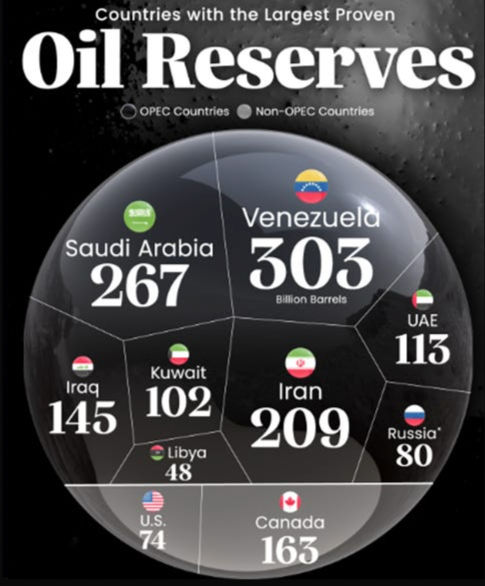
With the largest oil reserves on the planet [above], Shell’s main interest is developing the Dragon field with an estimated 4.5 trillion cubic feet of gas that Shell can liquefy and export to its LNG facility in Trinidad and Tobago.
BP signed a deal with PDVSA state oil company to develop the Cocuina-Manakin field that lies along the maritime border between Venezuela and Trinidad and Tobago. BP is also in the process of partnering with PDVSA to explore for gas in the Loran field.
Spain’s Repsol is returning to Venezuela for the first time since 1993, signing a new licensing deal with the government last month aimed at quickly doubling the nation’s existing crude oil production to 3 mb/d.
Italy’s Eni also signed a new joint venture deal with PDVSA and the Venezuelan oil ministry to explore and jointly develop the Junin-5 field in the Orinoco Belt that contains 35 billion barrels of undeveloped oil.
Eni tried to develop Junin-5 production in 2013 under the former Dictator Nicolás Maduro and his United Socialist Party of Venezuela. But the effort was constrained by years of Venezuelan Marxist underinvestment, operational disruptions, and uncertainty from American sanctions.
Two American companies, Hunt Overseas Oil Company and Crossover Energy, also plan to develop heavy and extra heavy crude in three sectors of the Orinoco Belt.
Deals were closed in the presence of Jarrod Agen, President Trump’s U.S. energy adviser and executive director of the National Energy Dominance Council. Agen ceremonially arrived to seal the deal in late April on the first direct Miami-Caracas flight in nearly a decade.
The U.S. companies are bringing technology that will allow production of oil for export and natural gas for local power generation. The goal is to quickly eliminate repeated black-outs that have plagued Venezuela for years.
President Trump appears to be angling for similar economic deals following the end of hostilities in Iran. Despite having the third largest oil and gas reserves on the planet [above], Iran oil production peaked in the late 1980s at about 6 mb/d, and was about 3.5 mb/d before the war.
If Iran agrees to policy changes that eliminate nuclear enrichment and sponsoring terrorism, President Trump seems willing to end American sanctions and sponsor economic partnerships with U.S. and international oil companies that would soon double Iran’s oil and gas production.
Mountain Top Times' Substack is a reader-supported publication. To receive new posts, subscribe below. To support my work, consider becoming a paid subscriber.


Thank you for sharing this insightful analysis of Venezuela’s oil boom! It raises so many questions about the potential global impacts. How do you think space waves technology could influence energy distribution in conflict areas like Iran? Looking forward to your thoughts!
Looking ahead is particularly useful when approaching a series of turns. Instead of focusing exclusively on the ball's current position, players can study the direction of the track and anticipate where the next adjustment will be necessary. slope 3d
Totally agree with the author, this topic is super relevant right now. Some time ago I came across https://silukr.org and now I often use it as a reference for finding useful information. For related questions, I also occasionally check https://whatiscfdtrading.org/ which is another solid source. Has anyone else used them? What do you think of their content? Personally, it saves me a ton of time.
Enjoy Snow Rider, a fun downhill sledding adventure featuring snowy tracks, dangerous obstacles, collectible presents, and exciting endless gameplay.
The emotional quality of heart touching punjabi shayari makes these expressions especially memorable. Punjabi poetry can describe relationships, family, friendship, love, and important memories in a very sincere way. I liked how the lines use simple language while still creating a strong emotional response. These expressions can be used for captions, messages, or personal reflection. Anyone who enjoys poetry that connects with real-life emotions can find plenty of meaningful thoughts in this style of Punjabi writing.